 English
 Español
 عربى
عربى
Home / News / Industry News / Centrifugal Fan vs Axial Fan: What Is the Difference and Which Do You Need?
Industrial fans fall into two fundamental categories: centrifugal fans and axial fans. Both move air — that is where the similarity ends. They work on different aerodynamic principles, produce different pressure and flow characteristics, handle different gas conditions, and suit entirely different application types. Specifying the wrong fan type for an industrial ventilation, dust collection, or process exhaust application results in either a fan that cannot develop the system resistance the ductwork requires or an oversized, energy-inefficient unit running far outside its optimal operating range.
For engineers, plant managers, and procurement teams selecting industrial fans for ventilation systems, dust collectors, industrial furnaces, boilers, or process exhaust applications, understanding the functional difference between centrifugal and axial fans — and knowing the criteria that determine which type is appropriate — is essential groundwork before specifying any equipment. This guide explains both fan types clearly and provides the decision framework for matching the right fan to each application.
How Does a Centrifugal Fan Work?
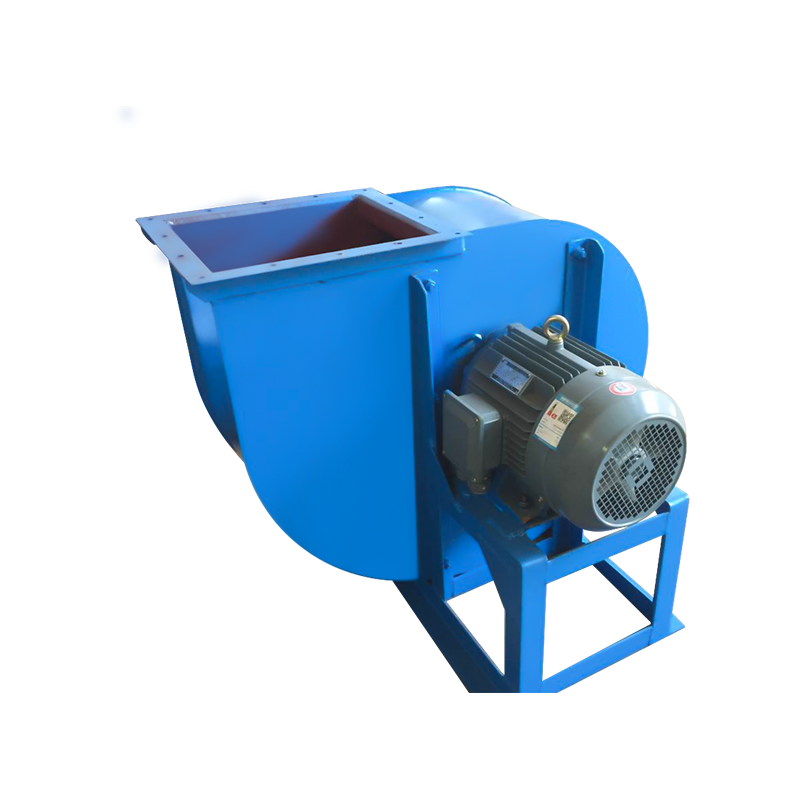
A centrifugal fan draws air in through an inlet at the center (eye) of a rotating impeller. The impeller accelerates the air outward by centrifugal force — the same principle that causes water to fly outward from a spinning wheel. The air exits the impeller at high velocity in the radial direction (perpendicular to the shaft axis), is collected by the surrounding scroll-shaped casing (volute), and is discharged through an outlet that is typically oriented at 90° to the fan inlet. The conversion of velocity into pressure happens both within the impeller passages and in the expanding volute casing.
The key result of this mechanism is that centrifugal fans are pressure-developing machines. They can build substantial static pressure — resistance to flow — while maintaining their airflow output. This makes them effective at moving air through long duct runs, through filters and heat exchangers, against damper resistance, and through systems with significant flow restriction. Centrifugal fans are also well-suited to handling air that contains dust, moisture, or gas mixtures, because the design accommodates contaminated airstreams without the fan performance degrading rapidly as the gas composition changes.
How Does an Axial Fan Work?
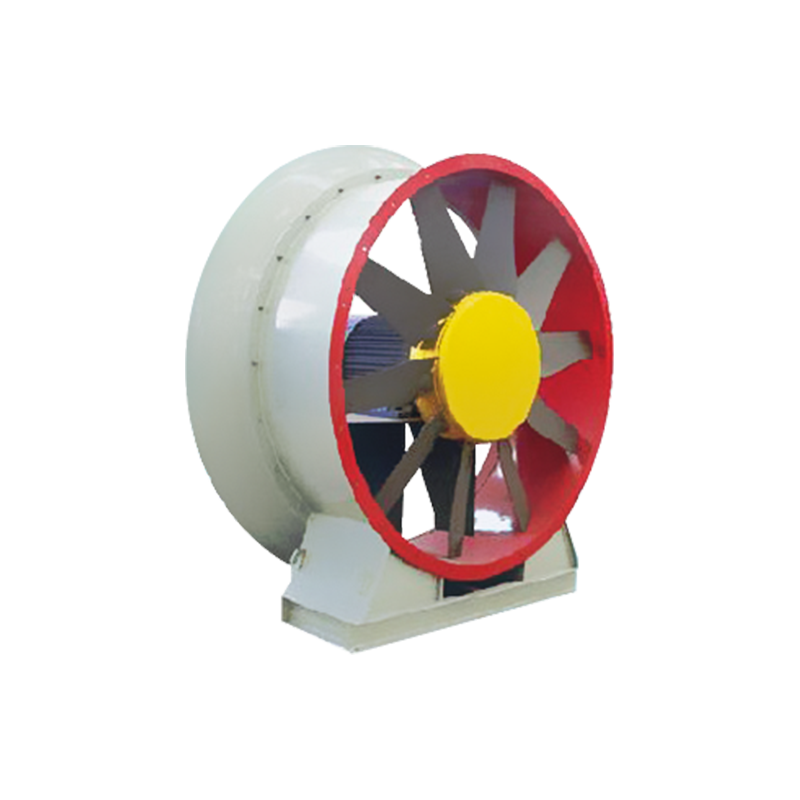
An axial fan moves air along the axis of the fan shaft — in the same direction the shaft points, like a propeller or aircraft engine fan. Air enters the fan parallel to the shaft, passes through the rotating impeller blades, which impart energy to the air and generate a pressure rise, and exits also parallel to the shaft. The impeller is mounted in a cylindrical casing that fits closely around the blade tips, minimizing the air that recirculates around the blade ends without contributing to useful airflow.
Axial fans are high-flow, low-to-medium-pressure machines. Their design is optimized for moving large volumes of air with relatively low resistance in the system — straight-through ductwork, open-area ventilation, heat exchanger cooling, and applications where the duct system is short and unobstructed. When system resistance is low, axial fans achieve this high-volume airflow at lower power consumption than a centrifugal fan sized for the same duty. However, as system resistance increases — longer ducts, more bends, filters, process equipment — axial fan performance drops off much more steeply than centrifugal fan performance.
Side-by-Side Comparison: Centrifugal Fan vs Axial Fan
| Property | Centrifugal Fan | Axial Fan |
|---|---|---|
| Air flow direction | Radial — enters axially, exits at 90° to the inlet | Axial — enters and exits parallel to the shaft |
| Static pressure capability | High — can develop substantial pressure against system resistance | Low to medium — performance drops sharply with increasing system resistance |
| Volume flow at low resistance | Good, but not optimized for minimal-resistance systems | Excellent — highest volume flow for a given power at low resistance |
| Efficiency at high system resistance | High — remains efficient across a broad resistance range | Poor — efficiency falls rapidly when system resistance increases beyond the design point |
| Handling of contaminated air (dust, moisture) | Very suitable — blade and casing design accommodate dust-laden and humid air; specialized dust-extraction models available | Limited — blade fouling and imbalance from dust accumulation are significant maintenance problems in contaminated airstreams |
| Noise level | Generally lower at equivalent duty | Higher — blade-passing-frequency noise is characteristic of axial fan operation |
| Physical size for equivalent duty | Larger, heavier | More compact for equivalent volume flow |
| Installation orientation | Inlet and outlet at 90° — requires duct routing to accommodate direction change | Straight-through — installs directly in a duct run without a direction change |
| Typical applications | Dust collection systems, industrial furnace ventilation, boiler forced draft/induced draft, process exhaust with significant duct resistance, pneumatic conveying, fume extraction | General building ventilation, cooling tower fans, heat exchanger cooling, mine ventilation (main heading), tunnel ventilation, short straight-duct runs |
When Should You Choose a Centrifugal Fan?
A centrifugal fan is the appropriate choice when one or more of the following conditions apply:
The system has significant duct resistance. Any ventilation or exhaust system with long duct runs, multiple bends, dampers, filters, heat exchangers, or process equipment in the airstream creates resistance (measured as static pressure in Pascals or mm H₂O) that the fan must overcome while still delivering the required airflow. Centrifugal fans are designed to develop this pressure. If the system resistance at the required airflow exceeds approximately 300–500 Pa, a centrifugal fan is almost always required — an axial fan at the same duty would be operating well outside its performance curve.
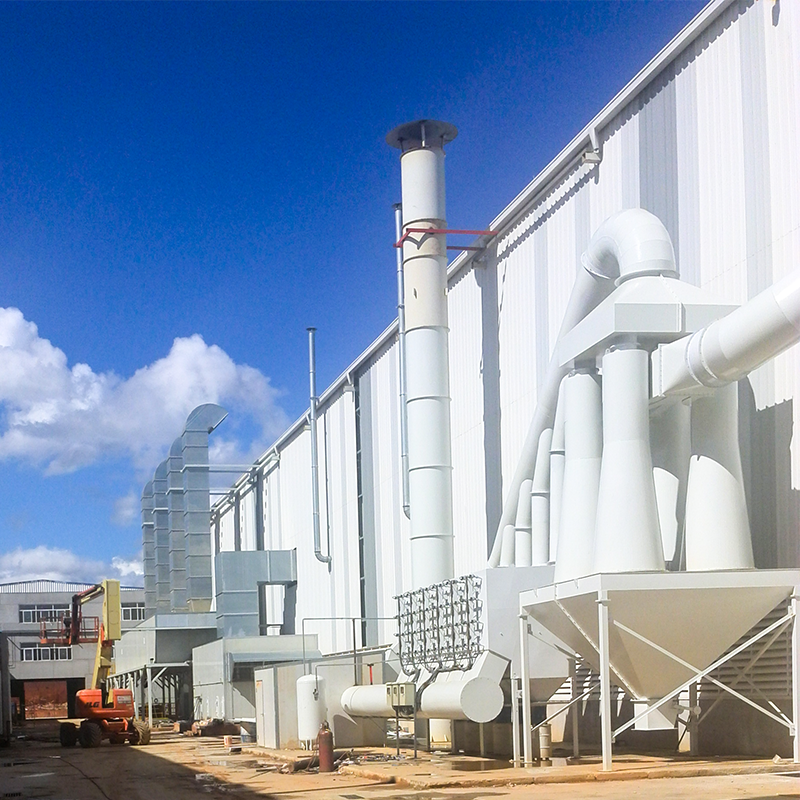
The air contains dust, particles, or moisture. In dust collection systems — particularly when used alongside bag filter dust collectors as part of a complete dust control system — the fan handles air with residual fine particles after the collector, and potentially high-humidity exhaust from process operations. Centrifugal fans designed for dust-laden service (such as the C6-48 and C4-73 series) have impeller and casing geometries that prevent buildup, are built from abrasion-resistant materials where needed, and maintain balanced operation even when fine particle contact occurs over extended use. Using an axial fan in a dust-laden airstream leads to rapid blade fouling, progressive imbalance, vibration, and bearing failure.
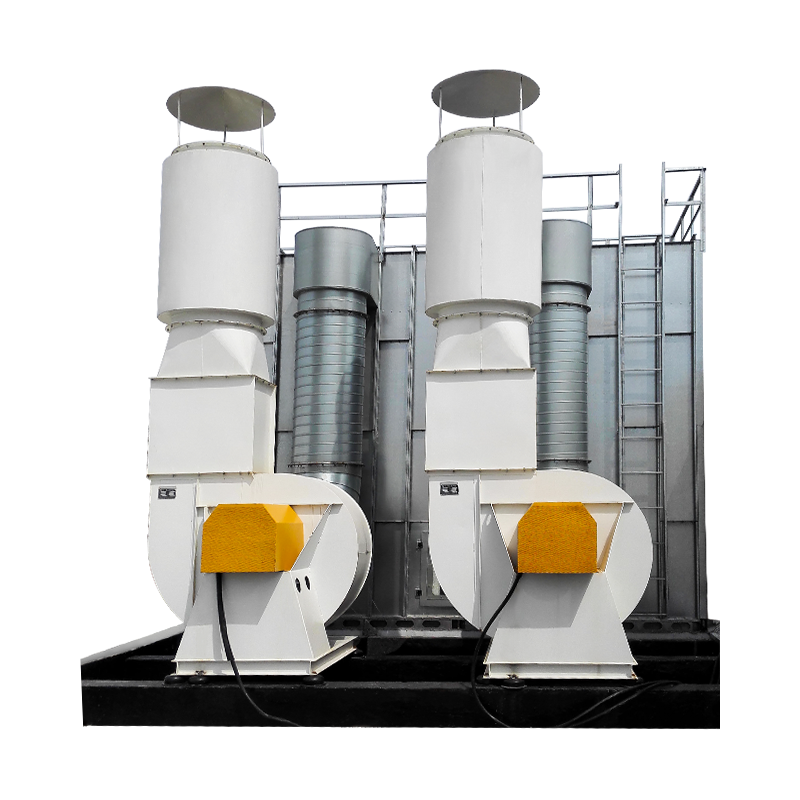
The application is a boiler forced-draft or induced-draft system. Industrial boiler ventilation — both forced draft (blowing combustion air into the burner) and induced draft (drawing combustion products from the firebox through the flue) — operates against substantial system resistance from the boiler internals, ductwork, and flue. Dedicated boiler fan series (G4-73 for forced draft, Y4-73/Y5-47/Y5-48 for induced draft) are centrifugal designs matched to boiler system characteristics including elevated gas temperatures in the induced draft path.
Noise control is a priority. In installations near occupied areas — plant control rooms, administrative buildings adjacent to industrial facilities, food processing plants with noise standards — centrifugal fans operating at equivalent duty typically generate lower noise levels than axial fans of equivalent capacity, because the blade-passing frequency noise that is characteristic of axial fan operation is absent from the centrifugal design.
When Should You Choose an Axial Fan?
An axial fan is the appropriate choice when:
The system resistance is low, and airflow volume is the priority. General building ventilation, tunnel ventilation, mine ventilation along open headings, and cooling tower fan applications all involve moving large volumes of clean air through minimal resistance. Axial fans excel in these applications — they deliver higher volume flow per unit of power consumption than centrifugal fans when system resistance is low, making them the energy-efficient choice for large-volume, low-resistance duties.
Straight-through installation is required. An axial fan installs directly in a duct run with inlet and outlet along the same axis — the duct goes straight through the fan. This simplifies the duct layout and avoids the 90° direction change that centrifugal fan installation requires. In retrofit applications where space for a centrifugal fan scroll and discharge duct routing is unavailable, an axial fan that fits within the existing duct run is a practical solution, provided the system resistance is within the axial fan's capability range.
A compact installation with high volume flow is needed. The axial fan's straight-through design and relatively compact cross-section for a given volume flow capacity make it appropriate where floor space or headroom is constrained. The T35 series axial fan, for example, is designed with an optimized airfoil impeller and cylindrical hub structure specifically to achieve high volume flow in a compact installation footprint.
Understanding Centrifugal Fan Series: Which Type for Which Application?
Centrifugal fans are not a single product — different series are engineered for different duties, and selecting the correct series for the application is as important as choosing the fan type over axial. The main centrifugal fan categories by application are:
General-purpose ventilation centrifugal fans (4-72, T4-72, 4-79, 9-19, 9-26 series): Designed for ventilation of buildings, air supply for industrial processes, and general industrial ventilation duties where the air is relatively clean and the system resistance is moderate. These are the standard industrial fans used in the widest range of ventilation applications and are available in a broad range of sizes and pressure ratings.
Dust-removal centrifugal fans (C6-48, C4-73 series): Specifically designed for air that contains dust, woodchips, shavings, and similar particulate applications in grinding, woodworking, pneumatic conveying systems, and dust collection, where the air leaving the dust collector still carries residual fine particles. Impeller geometry and material selection in these series are optimized for contaminated airstream service.
Boiler induced draft and forced draft fans (G4-73, Y4-73, Y5-47, Y5-48, GG2-10, GY2-10 series): Engineered for the specific pressure, temperature, and gas composition requirements of power plant and industrial boiler systems. Induced draft fans on the flue gas side handle high-temperature combustion products and require materials and bearing arrangements suited to elevated gas temperatures.
Frequently Asked Questions
Can I replace a centrifugal fan with an axial fan to save space?
Only if the system resistance at the required airflow is within the axial fan's pressure capability, typically below 300 Pa for standard industrial axial fans. If the system resistance is higher than this, an axial fan cannot develop the pressure needed to push air through the system at the required flow rate, regardless of its motor power. Before substituting fan types, calculate the system resistance (or measure it on an existing installation with a manometer) and compare it to the replacement fan's pressure-flow curve at the required operating point. If the operating point falls within the axial fan's curve, substitution is technically feasible. If it falls outside, a centrifugal fan is required.
What causes a centrifugal fan to surge, and how do I prevent it?
Surge in a centrifugal fan occurs when the system operating point moves to the left of the fan's peak pressure point on the pressure-flow curve — into the unstable region where small flow reductions cause large pressure drops, leading to pulsating, unstable flow. Surge is typically caused by partially closed inlet or outlet dampers throttling the airflow below the fan's stable operating range, or by a system that has been designed with much higher resistance than the original specification. Prevention: ensure the system dampers allow the fan to operate to the right of its peak pressure point under all expected operating conditions, and avoid prolonged operation at very low flow rates.
How does fan blade design affect performance in centrifugal fans?
Centrifugal fan impellers are available in three blade orientations, each producing different performance characteristics. Forward-curved blades produce high flow at lower pressure and reach their peak power output at the design flow point — they are compact but require careful motor sizing to avoid overloading at high flows. Backward-curved (backward-inclined) blades are the most aerodynamically efficient, with peak efficiency at the design point and non-overloading power characteristics — as flow increases beyond design, power consumption does not rise unstably. Radial (straight) blades are the simplest and most robust, used in dust-laden and corrosive service where blade fouling resistance and easy cleaning are more important than peak aerodynamic efficiency.
Industrial Centrifugal Fans and Axial Fans from ZhongXing Environmental Protection Machinery
ZhongXing Environmental Protection Machinery Co., Ltd., located in Tianmu Lake Industrial Park, Liyang, Jiangsu, manufactures centrifugal fans across the 4-72, 4-79, 9-19, 9-26, C6-48, C4-73, G4-73, Y4-73, Y5-47, and Y5-48 series, as well as the T35 axial fan series, for industrial ventilation, dust collection, boiler, and process exhaust applications. All products carry ISO9001:2015 quality management certification and European CE product certification. Fans are available individually or as part of integrated dust collection systems combining bag filter dust collectors, fans, and screw conveyors.
Contact us to discuss your application requirements and receive a fan selection recommendation and quotation.
Related Products: Centrifugal Fan | Axial Fan | Bag Filter Dust Collector | Screw Conveyor